
Notes from an Authoritarian Year
How the rituals of power, fear, and obedience hardened in 2025, and why 2026 must be the year they are broken.

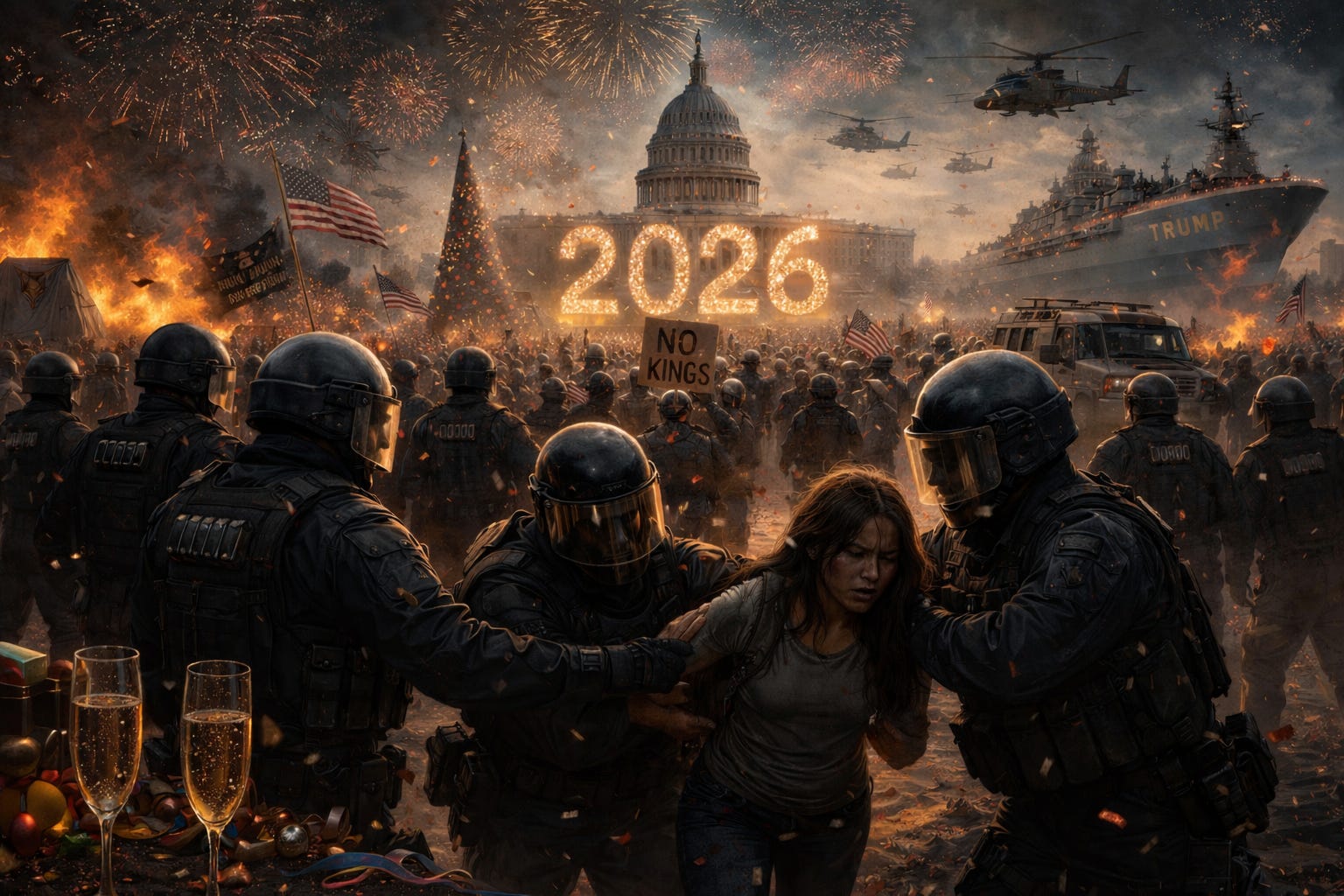
Authoritarianism does not always arrive in jackboots. Sometimes it comes dressed as nostalgia. Sometimes as efficiency. Sometimes as law and order, wearing a flag like a bandage over a wound it refuses to heal.
In 2025, the United States did not wake up one morning and declare itself an authoritarian state. It did something far more American: it normalized it.
The year unfolded not as a coup, but as a series of gestures: symbolic, administrative, bureaucratic, theatrical. Each one small enough to defend. Each one large enough to matter. Together, they formed a language of power that spoke not to reason, but to fear.
The first thing authoritarians do is rename the world. Words are borders. Control the words and you redraw the map.
So the Department of Defense was rechristened the Department of War. Mountains were renamed. Waters were re-baptized. Geography was conscripted into ideology. The land itself was told to remember a different story.
Ships were christened instead with the name of a living man. A republic’s military hardware turned into a personal monument. This is not vanity alone; it is a declaration. The state does not belong to the people. The people belong to the state. And the state belongs to one man.
Authoritarianism thrives on spectacle. It needs the choreography of dominance. It needs uniforms and cameras and force that is seen as much as it is used.
In 2025, masked federal agents appeared in immigrant neighborhoods; unidentified, unaccountable, unanswerable. They took people from workplaces, from schools, from courthouses. Not because secrecy is efficient, but because fear is contagious. A government that hides its face teaches the public to lower theirs.
ICE raids were not merely enforcement actions; they were performances. They reminded millions that legality is conditional, that belonging can be revoked, that the law does not protect you- it hunts you.
Detention numbers rose. Deportations accelerated. Communities learned the new grammar of survival: don’t gather, don’t protest, don’t speak too loudly, don’t trust anyone who asks questions.
At the same time, the military drifted inward. Troops appeared on domestic streets. The boundary between foreign war and civilian life, once treated as sacred, was treated instead as inconvenient. When the state practices war at home, it no longer needs enemies abroad.
Authoritarianism also fears ideas. It always has. Books are dangerous things. They teach people that the world can be otherwise.
So in 2025, libraries were purged quietly. School curricula were combed for forbidden language. Teachers were warned. Universities were disciplined. “Indoctrination” became the word used to describe history told honestly.
Race became unspeakable. Gender became unsayable. Empire became invisible.
This was not censorship, we were told. It was neutrality. But neutrality is what power calls itself when it wants to be unquestioned.
Journalists felt the temperature change before anyone else. Threats multiplied. Assaults increased. Press access narrowed. Lawsuits loomed like weather systems. When the press becomes the enemy, truth becomes contraband.
For the Year That Is Coming
And yet.
Authoritarianism has a weakness it can never eliminate: it depends on our obedience. Not our love. Just our compliance. Our exhaustion. Our willingness to believe that resistance is pointless, that the machinery is too large, that the moment has passed.
It never has.
Every empire tells itself it is permanent. History laughs.
In 2025, the streets spoke. Millions showed up; imperfect, uncoordinated, unfinished, but present. We refused the lie that silence is safety. We refused the lie that fear is maturity.
That is where hope lives now. Not in institutions that have already bent. Not in courts that hesitate. Not in elections drained of consequence. Hope lives in people who decide together not to cooperate with their own erasure.
In 2026, our resistance will need to be louder. More organized. Less polite. It will have to move from spectacle to strategy, from outrage to interruption. Unions that strike. Students who shut things down. Workers who refuse orders. Teachers who keep telling the truth. Artists who refuse euphemism.
Authoritarianism wants us isolated; alone with our fear, scrolling through it at night, convinced everyone else has already surrendered.
The antidote is solidarity.
Not the comfortable kind. The dangerous kind.
The kind that links arms across difference. The kind that accepts risk. The kind that remembers that freedom is not granted by power; it is taken back, repeatedly, by people who refuse to disappear quietly.
The fireworks will fade. The confetti will be swept away. The numbers will change.
And what must also change is our willingness to comply.
2026 does not belong to them yet. It is still up for grabs.
What happens next depends on how many of us decide that obedience is no longer an option.